
Catalog Numbers are from the Confederate States of America Catalog and Handbook of Stamps and Postal History
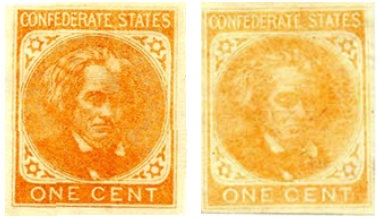
Left: Deep Orange - Right: Orange
Jean Ferdinand Joubert De La Ferté (1810-1884) designed and engraved the CSA 1-cent John C. Calhoun issue. There were 400,000 stamps invoiced, printed from one four-hundred-subject electrotype plate consisting of four panes of 100 subjects. The printing plate consisted of four panes of 100, resulting in a printed sheet of 400 stamps. Prior to shipment to the Confederacy, the sheets were cut into panes of 100. No gutter multiples are known except for the half-sheet of proofs retained in London by De La Rue. That half-sheet has since been broken up and is in collector hands. Plating has not been attempted as complete panes still remain. The stamps were printed on thin hard-surface paper with colorless gum; they were imperforate. Impressions are clear and distinct.
Color shades include deep orange, light orange, and yellow; the latter two likely due to fading. Since there was only one printing of this stamp, one would not expect to find any variation in the color.
Forensic philatelist Harry G. Brittain, PhD, wrote a paper for the 3rd quarter 2026 Civil War Philatelist in which he described the source and nature of the color degradation, similar to some of the paintings of Vincent van Gogh, which suffer from the same fate, most notably van Gogh's Sunflower series.
De La Rue described the ink as fugitive (it runs when subjected to water). On the CSA 14 stamps, the orange color of the stamp was due to the use of lead chromate as the pigment. The depth of color was modulated by lead sulfate. The cause is the inclusion of lead sulfate in the ink, which makes the chromate photosensitive. The same reaction caused the fading of van Gogh’s yellows. It is likely that the color was initially a vibrant orange that faded to lighter orange shades or yellow over time.
These stamps were printed and delivered, but never issued. Even though the printing number was low, the stamps are not particularly rare because most survived. There was a one-cent rate for drop circulars and effective July 1, 1863, for all circulars, pamphlets, and periodicals not exceeding one ounce in weight. The stamps appeared on the Confederate Post Office stamp order form, indicating they were held in inventory at Richmond.