
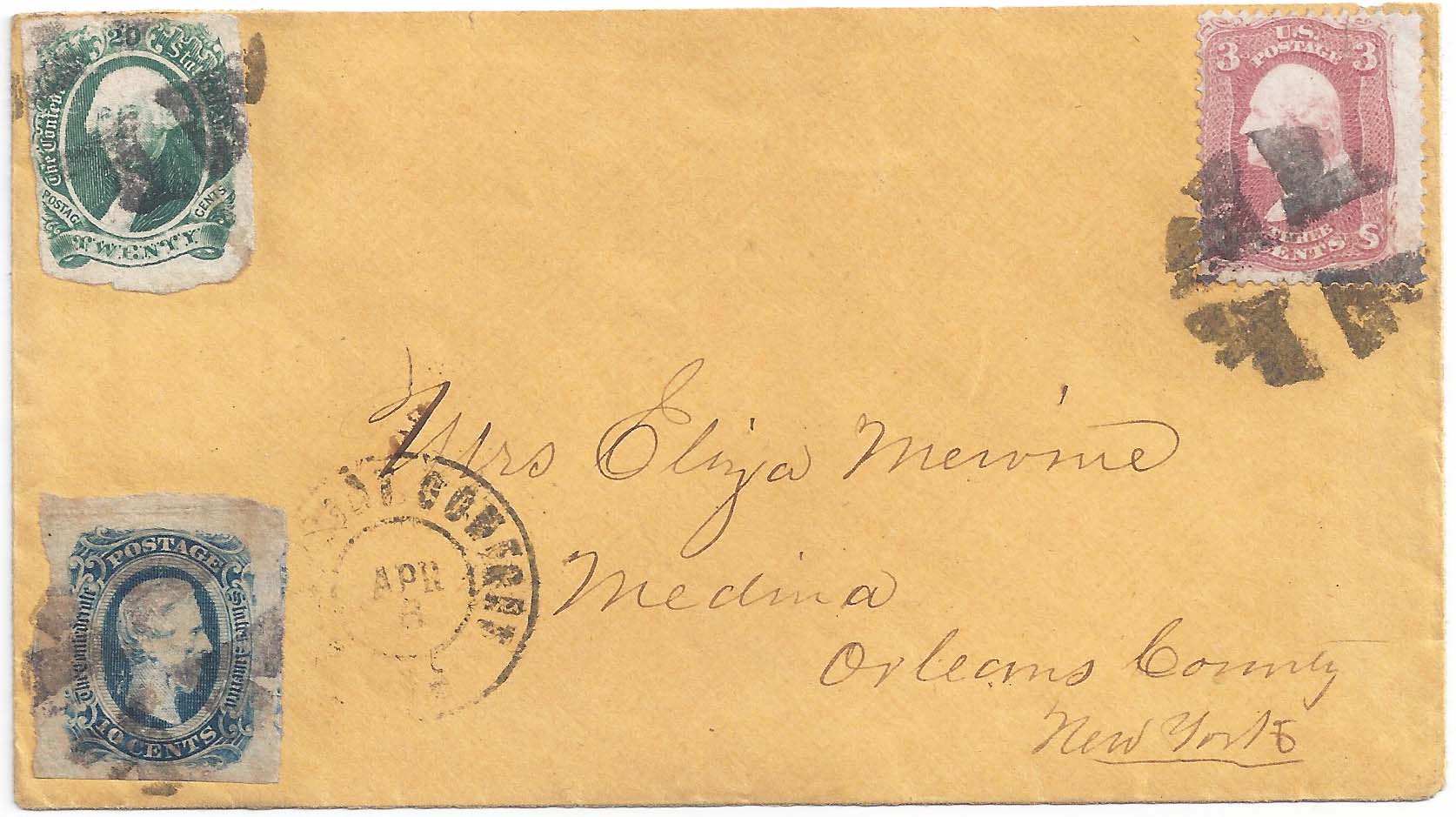
 Click on image to enlarge.
CSA 13, 20¢ green used with CSA 12-KB, 10¢ deep blue, and US 65, 3¢ rose – the three stamps each tied by matching quartered cork cancels; light strike of OLD POINT COMFORT VA. APR. 6 (1865) double circle datestamp on a clean cover to Mrs. Eiza Mervine, Medina, Orleans County, New York. The original enclosure was from Union soldier Pvt. Henry G. Mervine of the 27th New York Artillery. Regrettably, the letter no longer accompanies; it was lost after it was sold to Erivan Haub. Mervine wrote (in part): "We are situated in this rebel Capitol, the possession of which has cost the lives during the last three years of so many score thousands...I hear we are not to remain in Richmond, but to push on after the retiring rebel army...I would like much to appropriate some little pretty toys lying around loose...though we are ordered not to touch them," etc. Whether the last remark refers to stamps, or something of more value, is not known, but a federal post office clerk obviously indulged the sender, who created a unique and unusual use three days before Lee's surrender on April 9, 1865. Richmond fell to Union troops on April 3rd. In particular, the Keatinge & Ball stamp has enormous margins. Ex Gabriel and Erivan Haub with 2022 PF certificate stating the Confederate stamps did not represent any rate. A choice and significant showpiece, the perfect ending for any Civil War exhibit. $2,000.
Henry Gird Mervine, son of William and Amanda Maria Crane Mervine, was born in Cedar Lake (Herkimer County), New York on January 12, 1822. He married Eliza H. Fairman; the couple had five children. The 1860 census shows the Mervines living in Ridgeway (Orleans County), New York, where Henry Mervine was employed as a day laborer. On August 18, 1862, Mervine enlisted as a private in the 17th New York Light Artillery Battery at Medina, New York. He continued to serve with the 17th through the war and by the time he mustered out on June 12, 1865, he was serving as a clerk in the battery. The 1870 census lists Henry G. and Eliza Mervine among the residents of Canandaigua (Ontario County), New York, with Henry Mervine working as a pension agency clerk. By 1880, the Mervines were living in Syracuse (Onondaga County), New York. Henry Gird Mervine died in Canastota (Madison County), New York on November 7, 1895, and was buried in Oakwood Cemetery, Syracuse. Two letters from the same correspondence and same time frame were acquired by the Virginia Tech Special Collections and University Archives in 1989, both were addressed to “Lizzie” (Eliza), one written from the Petersburg trenches in July 1864, and the second on April 8, 1865. He briefly describes the suffering of local residents through lack of luxuries and necessities and the Union Army's efforts to relieve them. Mervine continues that citizens of Richmond have sent a committee to General Lee, asking him to surrender. "(T)he thing is nearly played out," he wrote. Indeed.